Start Trading Now
Sign up for ZitaPlus, where knowledge and personalized support come together for your success.
Open Real Account Open Demo Account
For much of the bull market, mega-cap technology and AI-related companies have carried an outsized share of the gains. As their valuations and market capitalizations grew, so did their influence on the S&P 500, making moves in a relatively small group of stocks powerful enough to shift the entire index.
That can make the headline number misleading. Because the S&P 500 is weighted by market capitalization, the index can rise even when many of its members are flat or falling.
This is where market breadth becomes useful. Looking at how many stocks and sectors are participating can show whether strength is spreading beyond the companies that have dominated the index in recent years.
That concentration has started to ease in 2026. Gains are spreading beyond the S&P 500's largest companies, with the average stock beginning to play a bigger role in the index's performance.
The shift is particularly visible in the S&P 500 Equal Weight Index, which contains the same companies as the traditional S&P 500 but gives each roughly the same influence. As of September 1, the Equal Weight Index had gained 13.35% year to date, compared with about 11% for the standard S&P 500.
The gap suggests that strength is no longer concentrated mainly at the top of the index. More companies are keeping pace with, and in some cases outperforming, the mega caps that dominated previous years.
This broader participation is one of the clearest signs that the character of the 2026 rally is changing.
Technology remains an important source of earnings growth, but financials, industrials, healthcare, energy and other areas have taken a larger role in the rally.
The composition of the Equal Weight Index illustrates the difference. Industrials currently represent around 16%, financials 15.9%, technology 14.7%, and healthcare 13.1%. That is a much more balanced sector mix than the traditional S&P 500.
Recent earnings have also provided support outside technology. This makes the rally less dependent on every major AI or mega-cap company delivering another exceptional quarter.
The rotation has extended beyond the S&P 500. Small-cap stocks have performed strongly in 2026, with the Russell 2000 gaining around 18% year to date, ahead of the S&P 500.
Small companies tend to be more sensitive to domestic growth, borrowing costs and credit conditions than multinational mega caps. Their stronger performance can therefore signal greater confidence in a wider part of the US corporate sector.
There is still a clear vulnerability. Treasury yields remain high, with the 10-year yield approaching 5%, which raises financing costs for smaller companies that often depend more heavily on borrowing. If yields keep climbing, the small-cap recovery could face a tougher test.
Earnings growth is spreading beyond technology, giving financials, industrials, healthcare and other sectors a larger role in the rally. Valuations are also encouraging rotation, as many of these companies offer profit growth at lower multiples than the mega caps that have led the market for years.
AI spending is widening the field further. Investment in data centers extends well beyond chipmakers to power, construction, cooling and industrial equipment companies.
Interest rates remain the main constraint. Stable borrowing costs would support smaller and more rate-sensitive stocks, while another rise in Treasury yields could slow the rotation.
The S&P 500 alone cannot show how many stocks are actually participating. A few very large companies can push the index higher even when much of the market is struggling.
Several indicators provide a clearer picture:
No single measure tells the full story, but together they can show whether an index rally has support beneath the headline number.
A broader rally does not necessarily require money to leave technology.
Mega-cap tech companies can continue growing while financials, industrials, healthcare and smaller companies also perform well. In that scenario, Big Tech becomes one contributor among several rather than carrying most of the index.
This distinction is important. Broadening is less about replacing the previous market leaders and more about reducing dependence on them. If earnings growth spreads across sectors while technology stays relatively strong, the S&P 500 has more sources of support.
The first days of September have already provided a test. The S&P 500 fell 0.71% on September 1, with declining stocks significantly outnumbering advancing ones. Rising oil prices and Treasury yields were major sources of pressure, while the 10-year yield has moved close to 5%.
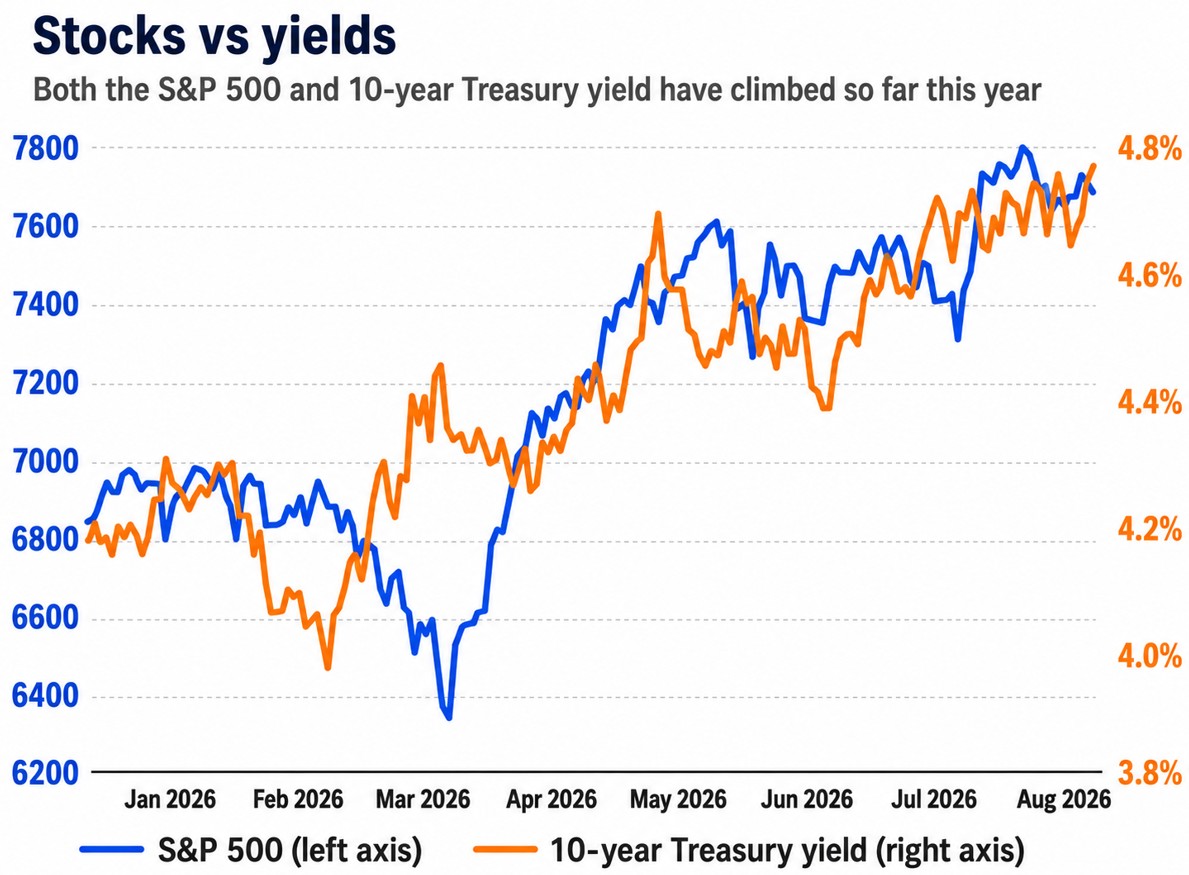
The 10-year Treasury yield has climbed roughly 80 basis points since March to around 4.8%. Higher yields increase borrowing costs and make bonds more competitive with equities, creating particular pressure for smaller and more leveraged companies.
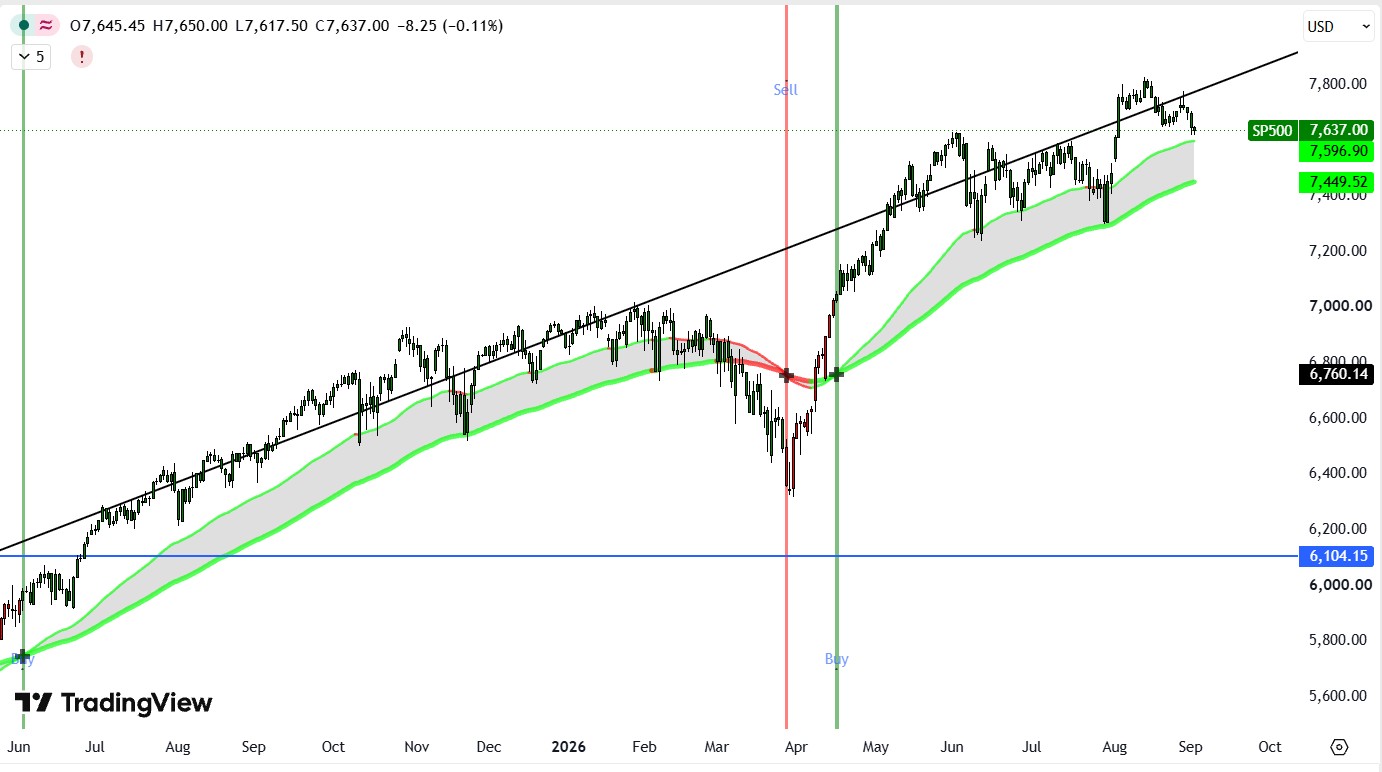
The S&P 500 has gained more than 11% in 2026, supported by a strong earnings season. With most major companies now having reported, the next stage of the rally will depend more heavily on economic growth and future earnings expectations.
The broader trend therefore has several tests ahead: Treasury yields, inflation, employment and earnings revisions. If strength continues across sectors and smaller companies despite those pressures, the case for a more durable broadening becomes stronger.
The headline S&P 500 level may not be the best measure of what happens next. The more useful signals could come from the stocks underneath it.
September started with a reminder of that distinction. On September 1, declining stocks outnumbered advancing stocks by roughly 2.8 to 1 on both the NYSE and Nasdaq. The S&P 500 fell 0.71%, but the weakness was broader underneath: transportation stocks lost 2.5%, while every member of the Philadelphia Semiconductor Index finished lower.
If the rally is genuinely broadening, that participation should eventually return rather than retreat back into a small group of mega-cap stocks.
The second-quarter earnings season gave stocks a strong foundation, but much of that reporting is now behind us. Attention is shifting back toward interest rates, economic growth and future profit expectations.
That creates a different challenge for the broader market. The S&P 500 is still up more than 11% in 2026, even as the 10-year Treasury yield has climbed more than 80 basis points since March. Strong earnings have helped stocks absorb that increase so far, but yields approaching 5% could make it harder for valuations to expand further.
Smaller companies and rate-sensitive sectors may face the biggest test. For the rally to keep spreading, their earnings will need to justify the gains even with borrowing costs staying high.
The 2026 rally has become less dependent on a handful of mega-cap technology stocks. Stronger equal-weight performance, gains in small caps and wider sector participation suggest more of the market is now contributing.
That broader strength still faces a test. September began with more stocks falling than rising, Treasury yields are nearing levels that could weigh on valuations, and another Fed rate hike is back in consideration.
The S&P 500 does not need every sector to rise to reach new highs. If gains continue to spread across more companies, sectors and smaller stocks, it would provide stronger evidence that the rally has genuinely broadened rather than simply found a new group of leaders.
Would like to learn how to look financial markets from a different angle? Then keep reading and invest yourself with ZitaPlus.