Start Trading Now
Sign up for ZitaPlus, where knowledge and personalized support come together for your success.
Open Real Account Open Demo Account
Technology companies raced to secure advanced processors, governments announced semiconductor initiatives, and investors followed every development involving companies like Nvidia, whose graphics processing units (GPUs) became the foundation of the modern AI boom. Access to computing power appeared to be the defining challenge of the industry.
As artificial intelligence expands from experimentation into large-scale deployment, attention is shifting toward a more fundamental requirement: electricity. Every AI model, every data center, and every automated system ultimately depends on energy. The more powerful AI becomes, the greater that requirement grows.
This shift is transforming the AI narrative. What began as a technology story is increasingly becoming an infrastructure story; one that involves utilities, power grids, energy producers, construction firms, and policymakers alongside software developers and chip manufacturers.
The future of artificial intelligence will depend on whether the physical systems supporting those algorithms can keep pace.
Artificial intelligence is often discussed as software, but behind every AI application sits a large amount of physical infrastructure. Training advanced AI models requires thousands of processors working simultaneously over extended periods. These systems perform trillions of calculations, processing enormous datasets to develop increasingly sophisticated capabilities.
Once deployed, AI systems continue consuming resources every time they generate a response, analyze information, or automate a task. As businesses integrate AI into products, customer service platforms, research tools, and operational workflows, demand for computing capacity continues to expand.
The growth becomes even more significant when multiplied across millions of users. Every prompt submitted to an AI assistant, every automated business process, and every machine-learning application requires servers operating around the clock. Those servers require electricity not only for computing but also for cooling and maintenance.
As AI adoption accelerates, the energy requirements grow alongside it.
One of the clearest signs of this transformation is the rapid expansion of data centers.
Around the world, technology companies are investing heavily in facilities capable of supporting advanced AI workloads. These sites contain thousands of processors, networking systems, storage infrastructure, and cooling equipment working together continuously.
What makes AI-focused data centers different from previous generations is their scale.
The computing density required for modern AI applications places unprecedented demands on electricity networks. Facilities that once consumed modest amounts of power are now operating more like industrial complexes, requiring dedicated energy resources and substantial infrastructure investments. This trend has triggered a wave of spending that extends far beyond the technology sector.
The construction of AI infrastructure supports demand for:
The economic impact of AI now reaches industries that may appear unrelated to software development. The expansion of artificial intelligence is creating a physical economy alongside the digital one.
The growing relationship between AI and energy is changing how governments and businesses think about electricity. For decades, reliable power was considered essential infrastructure, but rarely a strategic advantage. Today, that perception is shifting.
Access to abundant and stable electricity increasingly influences where data centers are built, where technology investment flows, and how quickly AI projects can expand.
Several factors contribute to this shift:
The ability to generate and distribute electricity efficiently may become as important to future AI development as advances in hardware and software.
Most electricity networks were designed to support households, businesses, and traditional industrial activity. They were not designed with large-scale artificial intelligence in mind.
The rapid growth of AI infrastructure is introducing a new category of demand, one that is continuous, energy-intensive, and concentrated in specific regions. This creates challenges for grid operators and policymakers.
Expanding electrical capacity is rarely a quick process. New transmission lines, substations, and generation facilities require planning, investment, regulatory approval, and construction. These projects often take years to complete.
Meanwhile, demand for AI infrastructure continues to grow. This mismatch between the pace of technological expansion and the pace of infrastructure development is becoming one of the defining issues of the AI era. The conversation is gradually moving beyond processors and software models toward questions about energy supply, transmission capacity, and long-term resilience.
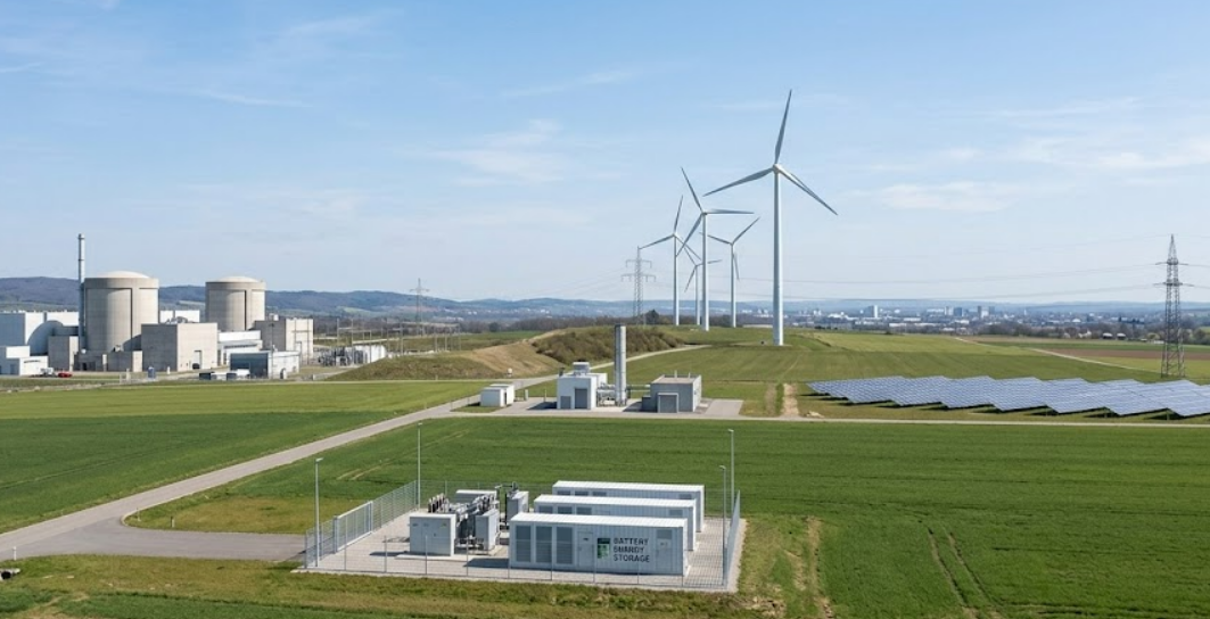
As electricity demand rises, attention is turning toward how that demand will be met. Different regions are pursuing different strategies, but the objective is similar: securing reliable power for future growth.
Several approaches are receiving increased attention:
Nuclear power offers stable generation with relatively low emissions, making it attractive for energy-intensive industries. Interest in nuclear projects has increased as technology firms seek dependable long-term electricity sources.
Natural gas remains an important component of many electricity systems due to its reliability and relatively rapid deployment compared with large-scale infrastructure projects.
Solar and wind power continue expanding globally, supported by improvements in storage technology and grid integration. These resources are expected to play a key role in supporting future electricity demand.
Battery systems and other storage technologies are becoming increasingly important as electricity networks adapt to changing consumption patterns and renewable generation.
The broader trend shows that discussions about AI increasingly lead back to discussions about energy.
One reason the AI transition matters is that its economic impact extends far beyond software developers and technology companies. While artificial intelligence is often associated with chatbots, algorithms, and cloud platforms, the infrastructure supporting these systems reaches into sectors ranging from energy and construction to manufacturing and utilities.
Few companies illustrate this transformation better than Nvidia.
Originally known for graphics cards used in gaming, Nvidia became one of the biggest beneficiaries of the AI boom as its processors emerged as the preferred hardware for training and operating advanced AI models. Demand for its chips surged as technology companies invested heavily in data centers and computing infrastructure, helping Nvidia become one of the world's most valuable corporations.
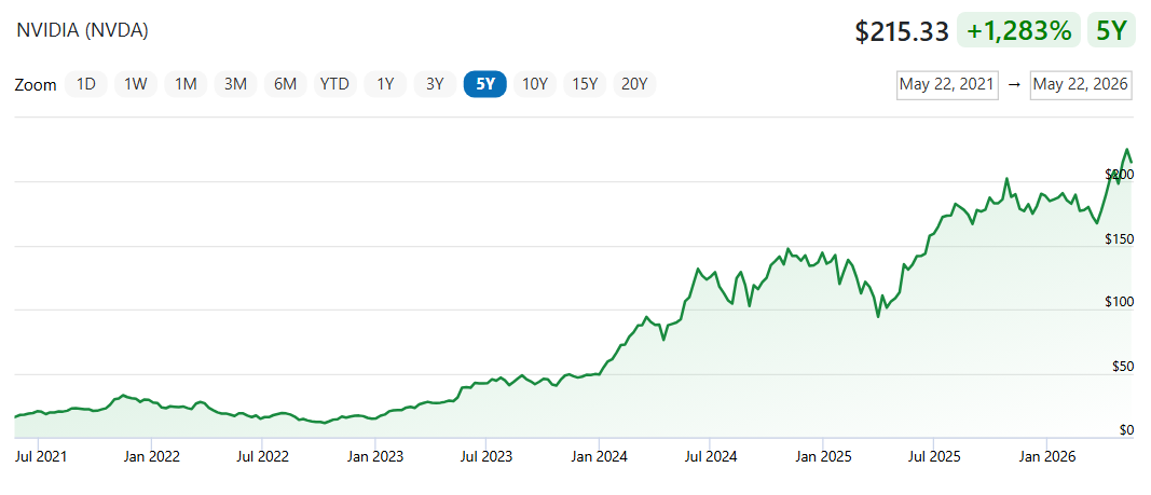
The scale of that growth has been extraordinary. Nvidia shares have delivered a five-year total return of roughly 1,283%, meaning a $1,000 investment made five years ago would be worth approximately $13,828 today. The stock has also gained more than 62% over the past year, reflecting continued confidence in the long-term expansion of artificial intelligence.
For a time, this rapid appreciation fueled concerns that the AI rally was driven more by enthusiasm than fundamentals. However, as adoption continues to spread and corporate spending remains strong, skepticism surrounding an "AI bubble" has gradually faded. Revenue growth across the sector, particularly in data-center infrastructure, suggests that demand is being supported by real-world deployment rather than speculation alone.
Competition within the AI industry is often described in terms of models, software capabilities, and semiconductor performance.
Those factors remain important, but the next phase of competition may involve more consideration.
Technology companies are now evaluating:
In this environment, strategic advantages are no longer limited to software development or chip design. Infrastructure quality is becoming a competitive factor in its own right.
Regions capable of providing stable energy and supporting large-scale digital infrastructure may find themselves attracting a greater share of future investment.

The remarkable progress of artificial intelligence has been powered by innovation, investment, and extraordinary advances in computing technology.
Companies like Nvidia helped make that progress possible by providing the hardware required to train and operate increasingly sophisticated models. Their success reflects the scale of demand created by the AI revolution. Yet as the industry matures, a broader reality is coming into focus.
Artificial intelligence depends on much more than processors and algorithms. It requires electricity, infrastructure, construction, cooling systems, transmission networks, and long-term planning.
The next chapter of AI growth will not be written solely by software engineers or semiconductor designers. It will also be shaped by utility companies, grid operators, infrastructure developers, and energy producers.
Would like to learn how to look financial markets from a different angle? Then keep reading and invest yourself with ZitaPlus.